
-
What types of materials does the Marine Epoxy bond to?
Marine Epoxy is designed to bond a wide range of materials commonly found in marine, construction, and repair applications. It adheres effectively to wood, fiberglass, metals such as aluminum and steel, ceramics, plastics, and composite materials. This versatility makes it ideal for boat repairs, woodworking projects, and general household or industrial tasks where strong, reliable adhesion is required. The epoxy creates a durable, long-lasting bond by filling gaps and forming a hard, structural layer that withstands vibration, moisture, and temperature fluctuations. For porous surfaces like wood, the epoxy penetrates small voids to enhance mechanical strength, while non-porous surfaces such as metal and fiberglass achieve chemical adhesion. This broad compatibility allows users to tackle diverse projects without needing multiple specialized adhesives.
-
How long does it take for the epoxy to reach full cure?
The full cure time for Brampton Marine Epoxy is 1 hour at standard room temperature conditions (approximately 70°F or 21°C). Colder environments may extend the curing period due to slower heat dissipation and chemical reaction times. High humidity can slightly increase cure times, while warmer temperatures often accelerate the process. For best results, it is recommended to allow the epoxy to cure undisturbed until it achieves full mechanical strength.
-
Can this epoxy be used on fiberglass, plastics, ceramics, and metal surfaces?
Yes, Marine Epoxy is formulated to bond effectively to fiberglass, PVC, ceramics, and metal surfaces. For fiberglass, the epoxy penetrates fibers and forms a solid, structural bond ideal for repairing boat hulls, panels, and composite parts. On PVC and ceramics, the adhesive provides reliable surface adhesion, although slight surface preparation such as sanding or cleaning may improve results. Metal surfaces, including aluminum and steel, achieve strong chemical adhesion with proper cleaning and degreasing before application. The versatility across these materials makes marine epoxy suitable for multi-surface repairs and hybrid projects, allowing users to apply a single adhesive solution across diverse components. Its waterproof and corrosion-resistant properties ensure that bonds remain stable even in wet or challenging environments.
-
Do I need a special dispensing gun for the cartridges?
Yes, using Brampton’s dispensing gun is highly recommended for compatibility, control, and efficiency. The gun allows for consistent mixing and application, especially for two-part epoxy formulas that require equal parts resin and hardener. By providing smooth, even flow of epoxy, the dispensing gun ensures the correct ratio is delivered without waste or uneven curing. Pairing with a mixing nozzle helps apply epoxy in tight spaces, along seams, or across intricate surfaces where hand mixing may be imprecise. Professional technicians often rely on dispensing guns to maintain repeatable quality and reduce cleanup time.
-
Can Marine Epoxy be used for water tanks or plumbing applications?
Yes, Marine Epoxy is commonly used for water tanks, plumbing repairs, and other applications where exposure to water or moisture is expected. Its waterproof formulation allows it to form durable, leak-resistant seals and bonds, making it suitable for repairing cracks, sealing seams, or bonding fittings in tanks and pipes. The cured epoxy creates a structural layer that resists hydrostatic pressure, vibration, and temperature changes, which is critical for maintaining long-term integrity. For potable water applications, it is important to verify that the specific epoxy product is certified as safe for contact with drinking water. Proper surface preparation, including cleaning, degreasing, and drying, is essential to ensure maximum adhesion and leak-proof results.
-
How strong is the adhesive bond after curing?
Marine Epoxy creates a highly durable and structural bond after curing, capable of withstanding significant stress, impact, and vibration. Once fully cured, it forms a rigid, chemical-resistant layer that adheres tightly to wood, fiberglass, metals, plastics, and other compatible surfaces. The strength of the bond depends on proper surface preparation, accurate mixing of resin and hardener, and adherence to recommended curing times. For most applications, the cured epoxy can handle the mechanical loads encountered in marine, plumbing, or DIY projects without failure. Its rigidity provides reinforcement in cracks or joints, making repaired structures more resilient than before. The bond is also resistant to moisture, temperature fluctuations, and chemical exposure, which is critical for marine and outdoor applications.
-
Does temperature or humidity affect working or cure time?
Yes, temperature and humidity can significantly influence both the working time and curing process of Marine Epoxy. Higher temperatures generally accelerate the chemical reaction, shortening working time but reducing overall curing duration. Conversely, cooler temperatures slow down the reaction, allowing longer working time but extending full cure periods. Humidity also plays a role, as excessive moisture can affect surface adhesion and may slightly delay curing. For optimal results, epoxy should be applied in a controlled environment with moderate temperature and low humidity whenever possible. Proper storage before use, keeping cartridges at recommended temperatures, helps maintain consistent performance. Understanding these factors allows for precise timing and maximizes bond strength, durability, and long-term performance.
-
How should I prepare the surface before applying Marine Epoxy?
Surface preparation is crucial for achieving maximum adhesion and durability with Marine Epoxy. Begin by cleaning the surface to remove dirt, grease, oil, rust, or loose debris. Use a solvent or mild detergent for thorough degreasing, especially on metal or non-porous materials. For smooth surfaces, lightly sanding the area creates micro-abrasions that improve mechanical bonding. Porous materials, such as wood or fiberglass, should be free of dust and splinters before application. Ensure the surface is dry, as excessive moisture can interfere with epoxy curing. For complex joints or cracks, filling gaps may require layering epoxy carefully. Accurate surface preparation ensures a uniform bond, reduces air pockets, and enhances the strength and longevity of the repair.
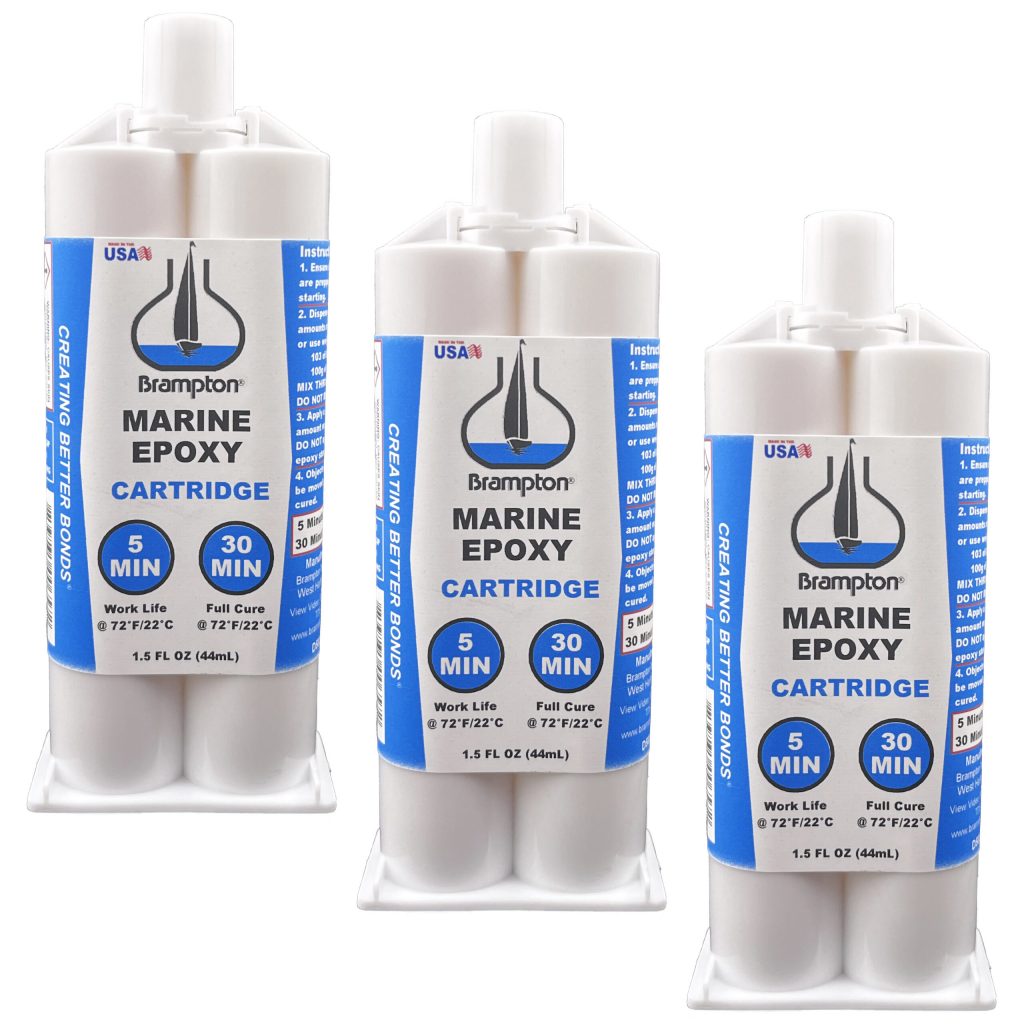
Marine Epoxy Cartridge Bundle
Price range: $29.23 through $71.45
Stock up and save with Extra Strength Epoxy Cartridge Bundles. Perfect for boating enthusiasts and DIYers who don’t want to run out mid-project. Available in packs of 3, 5, and 10, these bundles give you the best value while ensuring you always have high-quality epoxy on hand.
Description
Stock up and save with Extra Strength Epoxy Cartridge Bundles. Perfect for boating enthusiasts and DIYers who don’t want to run out mid-project. Available in packs of 3, 5, and 10, these bundles give you the best value while ensuring you always have high-quality epoxy on hand.
Properties
5-minute work life and 30-minute full cure at 72°F/22°C. Underwater bonds with fiberglass, wood, most plastics, ceramics, metal.
Mixing Ratios
Our waterproof epoxy is available in multiple container types to meet your dispensing needs: cartridge, syringe, and 2 bottle sets.
- Volume Ratio 1:1
- Weight Ratio Part A 103g : Part B 100g
Applications
Brampton Marine Epoxy cures underwater creating a waterproof bond making it perfect for:
- Marine & Boats
- Water & Fuel Tanks
- Showers & Drains
Sizes
0.85oz Syringe, 1.5oz Cartridge, 7oz Cartridge, 20oz Cartridge, 4oz Bottle Kit, 8oz Bottle Kit, 16oz Bottle Kit
California Proposition 65 Warning
This product contains chemicals known to the State of California to cause cancer and birth defects or other reproductive harm.